

Loved, Tendered, Murdered
- simplesimonem
- Aug 19, 2019
- 10 min read
The Love Me Tender Murders
On December 28, 1956 two sisters, Barbara and Patricia Grimes, left their Chicago home to see ‘Love Me Tender.’ Both young girls were head over heels for Elvis, and despite seeing the movie fourteen previous times, they just had to see the double feature at Brighton Theater. So, with $2.50 to share the girls set out for a night of fun with a curfew of 12:00 pm in mind. Afterall, they didn’t want to upset their mother who was funding their fifteenth viewing of ‘Love Me Tender.’ With smiles on their faces, and a home-made meal in their stomachs, the Grimes girls rushed to Brighton Theater in a flurry of excitement.
Little did they know, that a school friend of Patricia’s would wind up sitting just behind them in the theater. In fact, Dorothy Weinert would be the last person to see either Barbara or Patricia alive. Her last encounter with the girls was watching them buy popcorn as she left Brighton Theater not wanting to stay for the second movie.

Back home, as midnight approached and Loretta had heard nothing from the girls, her worries worsened. Sending her eldest children out to the bus stop, they waited in hopes of meeting Barbara and Patricia, but by 2:00am they called the police. Barbara and Patricia Grimes weren’t coming home. As a result, Chicago’s largest city-wide manhunt ensued. Hundreds of police officers, locals, and neighboring towns stood together in an attempt to find the missing young women. At the time, Barbara was only fifteen, and her sister Patricia was thirteen. Young, alone, and probably in danger, the town was overcome with empathy. They were going to find the girls.
However, as publicity surrounding the Grimes case grew, numerous phone calls of ‘sightings’ flooded police lines. In fact, there were so many calls that officers often couldn’t keep up with them. On one hand a report placed the Grimes girls at a record store listening to Elvis’ music, and on the other they were on a bus leaving Chicago. Even one of Patricia’s classmates called in claiming to have received two phone calls from Patricia two weeks after she vanished. Yet each of these leads proved false and unreliable. With nothing to grasp but air, Chicago officers proposed a theory of their own. They believed the Grimes sisters had planned their own disappearance, effectively vanished, and were heading to Nashville in hopes of seeing Elvis Presley in person.
Unfortunately, the theory grew so popular that Elvis himself became involved with the case. Addressing the public, he pleaded for the girls to be “good Presley fans,” and to “go home and ease their Mother’s worries.” But despite police insistence that Patricia and Barbara had run away, Loretta adamantly refused to believe them. To her, it made little sense. Neither daughter had taken extra money, clothes, or provisions, and they certainly wouldn’t have left the brand-new A.M. radio she’d bought them behind.

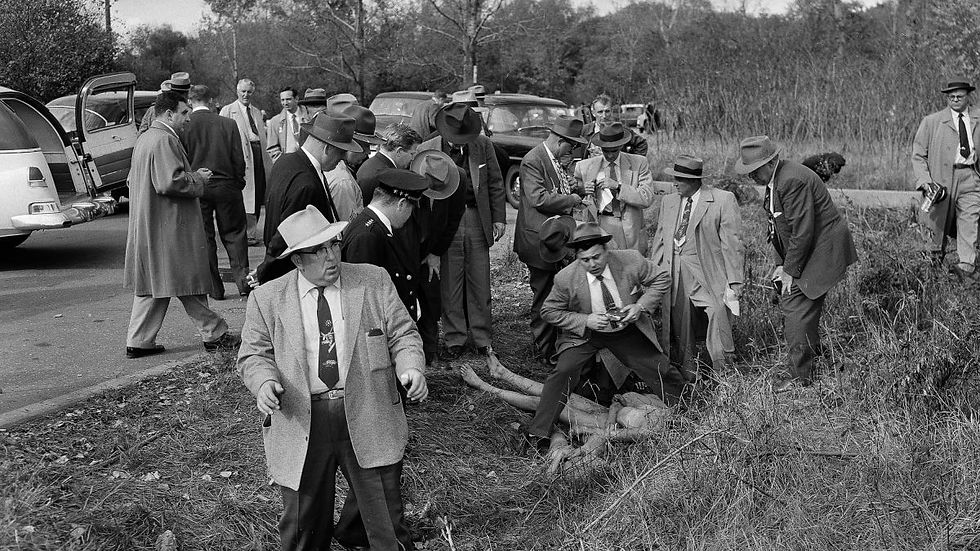
Thankfully, the rumors were put to rest on January 22nd,1957. Neither Patricia nor Barbara had run away in some dramatic ploy to meet Elvis. No, they were not as foolish, silly, or irrational as law enforcement, the public, and the media painted them to be. They were dead, found over the guard rail of a road, naked, and frozen. Something awful had befallen them, and if it hadn’t been for Leonard Prescott driving to the grocery store along German Church Road, they would never have been found.
Having perceived the bodies to be mannequins at first, Leonard returned home and collected his wife. Together, they investigated the scene and called the cops. Police arrived shortly after to inspect the bodies. Barbara, lay face down on the ground with Patricia resting atop her perpendicularly. The bodies had gone unnoticed due to snow, and a recent thaw was the only reason they’d been seen. However, the elements proved difficult throughout the case. Such frigid temperatures made sections of the autopsies difficult. Some, though, were easy. For instance, the girls were believed to have died within four hours of leaving home due to the presence of their dinner in their stomachs. On top of this, it was discovered that Barbara had sexual relations before dying, but lack of evidence made it impossible to rule rape as the cause. Oddly enough, the case was ruled a murder despite the only clear cause of death being, “secondary exposure to the elements,” as determined by the coroner.
Struggling to come up with something, investigators got a vague tip that led to the arrest of Edward Lee Bedwell. The man was 21 years old at the time and often described as a trouble making drifter who strongly resembled Elvis. Eyewitnesses claimed that Bedwell had entered a car and restaurant with the Grimes sisters the night of their deaths. As a result, police suspicions worsened, and Bedwell went on to write a 14 page confession to the murders. However, nothing in the admission indicated he’d been involved with the girls at all. In fact, Bedwell later recanted his confession claiming that police had bribed and beaten it out of him. With no concrete evidence connecting Bedwell to the case, he was released from police custody.

Here it seems the case reaches a permanent dead end, however, after hours of digging through old newspaper archives I managed to discover details lost overtime regarding the case. Coming back to Bedwell’s brief stint in police custody, it became clear that officers were grasping straws. Loretta had received up to nine ransom notes kept secret from the public as not to hinder investigation. This would insinuate that Bedwell had written them. In fact, police were certain he had. But Bedwell was borderline mentally retarded and couldn’t read or write making his detainment particularly odd. Under further investigation, it was discovered that the autopsies of the Grimes girls were most likely flubbed. Especially because forensic scientists and coroners were struggling to communicate, and even went so far as to with-hold information from one another. They were stuck arguing over the true cause of death. This was only worsened due to animals picking at the Grimes corpses and their prolonged exposure to the cold. It made any autopsy nearly inconclusive.
On top of this, a lead coroner in the investigation (Harry Glos) adamantly disagreed with his peers. While they insisted the girls died from second hand exposure to the elements, Glos claimed the girls were both beaten and molested before death. After publishing his findings and relaying information to the media, Glos was fired by his peers. But this isn’t the worst flub of procedure. No, local sheriff Loham revealed that he had conducted a 15 hour lie detector session on Bedwell which showed, “he was lying on so many points I can’t enumerate them. The man contradicts himself constantly.” However, lie detectors are known to be very flimsy pieces of evidence in any serious case, and a fifteen hour session is far above the 1-3 hour sessions typically used. And while examinations can last longer than three hours for criminal suspects, subjecting a mentally retarded individual to such an extensive test ( coupled with apparent abuse) only decreased the results’ validity.
Furthermore, Glos, went on record saying, “only half of the story has been told and I don’t know why the other half is being withheld and even though it will cost me my job, it (his contradictory conclusions) has been building up inside of me so long that I can’t hold it in any longer.” His colleague Jerry J. Keanes went on to question Glos’ credibility and credentials despite Glos’ twenty years as a police officer and five as a coroner.
Thankfully, the tension within investigative teams eased when a yellow sweater was found “…Wednesday inside a boarded-up concessions stand.” The sweater was a size 32 and “ Patricia was wearing a sweater of the same size and color when last seen.” Then, shortly after the sweater finding, another break in the case appeared. A new suspect, Walter Kranz, was taken into custody. Kranz, before the girl’s bodies had been found, contacted police stating the girls were dead. He gave a detailed and accurate description of where their corpses would later be found. When questioned, Kranz claimed that the information had come to him in a dream. But despite the incriminating details, Kranz was also released due to a lack of evidence connecting him to the crime.

Once again, the trail went cold, but a look at more articles revealed some interesting info. One year prior to the death of Patricia and Barbara Grimes, three young boys were also killed after attending a movie. The victims were Robert Peterson (14), John Schuessler (13), and his brother Anton (11). Both series of murders occurred within a 15month time frame. Like the Grimes girls, all three boys were stripped naked and dumped on the side of the road. While these three suffered head trauma, unlike the Grimes girls, Peterson had indications of defensive wounds. Having fought back, the encounter could have easily escalated leading to the visible trauma on the boys’ bodies. In comparison, neither of the Grimes girls gave any indication of defensive wounds or a resulting conflict from trying to resist their killer.
Strikingly, another similar murder occurred nearly a year after the Grimes girls died. A young 15 year old girl, Bonnie Scott, was found naked and discarded on the side of a road. While a man named Charles Leroy Melquist was later convicted for Bonnie’s death, he was not convicted for the deaths of Patricia and Barbara. Yet, all three bodies showed the same non-lethal wounds. Interestingly, Charles had a list of names which contained girls all throughout the neighborhood of the Grimes, and while the Grimes weren’t listed-many of their friends were. With such a high profile case and a potential serial killer at hand, the FBI finally involved themselves with the case. Specifically, after a ninth ransom note found its way to Loretta Grimes.
As mentioned before, Bedwell was ruled out of writing these notes, but that only meant the person responsible for tormenting Loretta remained free. Inspecting the first three letters, a few things became clear. The writer wanted $1,000, and series of instructions was to be followed flawlessly. Loretta needed to attend a department store, a church, and a downtown hotel in Milwakee at 11:00 am, and repeat the process at 11:00 pm. Under protection of the FBI, Loretta followed the given commands. Nothing happened. Tossing out the first eight notes, the ninth was kept to be inspected at a different time. And, to make matters worse, Loretta claimed that the previously discovered yellow sweater did not belong to Patricia.
As investigators prepared to search the crime scene of Barbara and Patricia once more, they were thwarted by a, “blanket” of snow, “nearly six inches deep,” that “ruled out plans for a foot-by-foot examination of the area in a hunt for physical clues.” And once again, any progress came to a screeching hault. It wasn’t until a new case popped up that new clues began to surface regarding the Grimes.
When six children identified a man who abducted or tried to abduct them within the past five months, Leon Clifford Webber Jr. made his way onto the suspect list. All of his victims ranged from the ages of 4-12 years old. A taxi driver, Edward Morrissey, placed Webber at a filing station not far from Gloria Kowalewicz’ (9) home. Gloria had been found several miles from home, in the woods, shot to death having been on her way to church that morning. On top of this, a detective claimed that Webber, who had a history of violent sex crimes, orally admitted to abducting another girl, Peggy McCarthy (7). Fortunately for this young lady, she managed to escape unharmed after being left in a northwest side forest preserve. She had screamed when Webber began to undress her effectively frightening him off and ran to a nearby highway.
However, what’s striking about the case is the location. In the same forest that Peggy had escaped, were the three boys’ bodies, and the Kowalewicz slaying was also in the forest preserve. Then, four miles from where Gloria Kowalewicz was found rested the bodies of Barbara and Patricia. What’s more, details later emerged indicating that the three Chicago boys’ autopsies were equally confusing as the Grimes. After taking only 4 hours to complete the exam on all three of the boys, coroners came back to report that the boys were strangled to death and received a “beating so vicious it must have been inflicted by more than one person.” However, none of the boys showed signs of broken arms, ribs, noses, or jaws, and that the head trauma was relatively focused on a singular area. The coroners also claimed that none of the victims were molested, but like the Grimes case, there were doubts amongst colleagues as to whether or not this was a true claim.
Unfortunately, little new evidence came to light other than a few fingernail scrapings pointing to a rare type of steel. Yet, nothing ever came of the clue and it was eventually forgotten. But with all the evidence, accounts, and reports in play we can now take a look at some theories.
One theory is that the separate killings aren’t connected in any way shape or form. They may have some coincidences, but they vary. For instance, the head trauma inflicted on the three Chicago boys compared to the lack of violence in the Grimes case seems odd for it to be the same killer. Truthfully, there may have just been more than one killer within the area preying on younger children. They’d be easy to overpower, confuse, and manipulate. Especially when alone and without adult supervision.
The second theory is that two killers worked together. It would make abducting groups of children, or pairs of children, much easier. While there’s no indication that any of the suspects or convicted killers above knew each other, it’s not out of the realm of possibility. Documentation in the 50’s wasn’t exactly pristine, and as this case shows, errors are made on the regular. With that being said, two killers working together can explain the variations in violence and style. One relying on physical harm whether it be a beating or the firing of a gun while the other relies on subtler means.
A third theory is that the murders were carried out by a singular person: Webber. The Chicago boys were his first victims. It can explain the violence, the irrationality, and maybe even the panic. A first time killer takes on too big of a load, and a victim fights back. Things turn violent and almost primal as Webber beats them, then strangles them to make sure the deed is done. He dumps the bodies in a forest with little thought. Webber learns from last time, and when the Grimes sisters fall into his hands there is no violence. They’re two women, young, slight in build, and easily overpowered if a grown man is being aggressive. He does what he wants- though I can’t definitively say what since the medical reports conflict so much-and leaves them in the cold. That explains the cause of death being secondhand exposure. Webber moves on and collects Gloria, alone, with no friend or partner, much younger than the last few victims, and shoots her taking no chances of a struggle or difficulty. Webber then tries again with Peggy McCarthy but she draws attention and he runs off.
And our last theory is simply that these crimes overlapped. Webber was responsible for his victims while Leroy was responsible for his. Could Leroy have abducted the Grimes as well as Bonnie? Sure, the evidence indicates that may have been the case. Could he have only been responsible for Bonnie? Yes. Similarly, Webber may have played a role in the Chicago boys’ deaths, but he might have had nothing to do with it. It’s very likely that more than one killer caught, or not, was involved with the slew of cases that hit Chicago over a two year period. Unfortunately, there are no definitive answers, and it’s likely the case will remain unsolved.


Comments